Lamar Valley Wildlife: What You Can See, When, and Where to Look
Lamar Valley is where Yellowstone's northern range opens out into grassland, and the park keeps the road through it open to cars all winter. That combination is unusual: in January you can drive into the valley, pull off, and watch bison from a legal 25 yards while every other road in the park carries nothing but snowcoaches. What you will not see in January is the summer list. Elk have moved, pronghorn have left the valley, both bear species are denning, and moose were never a Lamar animal. Here is the species-by-species answer, the stops the park itself names along the road, the dates that decide whether the trip is possible at all, what the weather does month by month, and who sells a tour into the valley.
The valley, as the park describes it
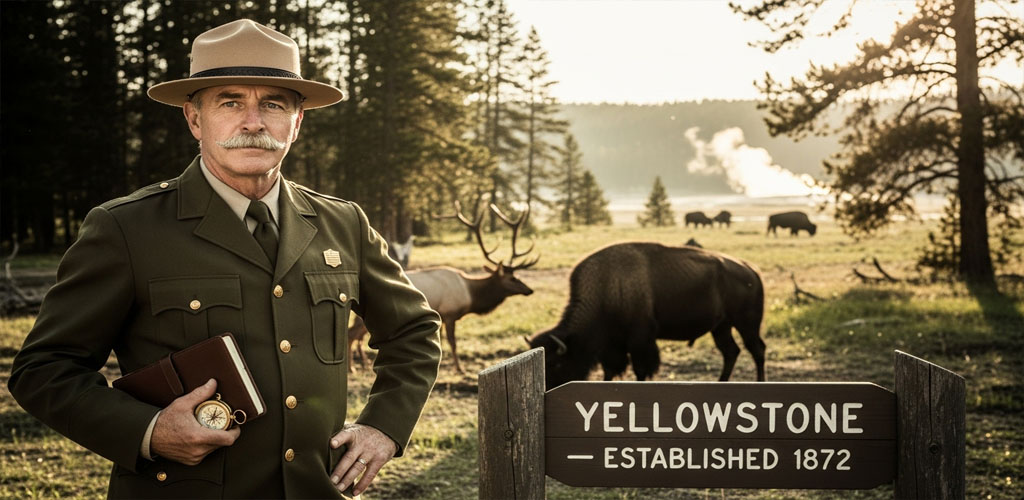
Yellowstone calls the northern range the grasslands where elk, bison, deer and pronghorn thrive, and calls it critical winter habitat for those large animals, which in turn feed several packs of wolves. The same page adds that coyotes are common in the valley and that occasional bobcat, cougar or red fox are reported. The park's own caution on that: animals migrate in and out of the park with the food supply, so what can be seen at any one place varies greatly with season and weather.
The park's own summary of what that produces is luck. The numbers and variety of animals you see, it says, are largely a matter of luck and coincidence. Everything below is about improving the odds, not scheduling a sighting.
What you can see, by season
| Species | Winter (Dec–Mar) | Spring (Apr–May) | Summer (Jun–Aug) | Autumn (Sep–Nov) |
|---|---|---|---|---|
| Bison | Yes — year-round range | Yes | Yes | Yes |
| Wolves | Yes — the northern range is one of the best places in the world to watch them | Yes | Yes | Yes |
| Coyote | Yes — common in the valley all year | Yes | Yes | Yes |
| Elk | Present but not the winter certainty — the park names Lamar for elk in summer; the northern herd winters along the Lamar and Yellowstone river valleys from Soda Butte to Gardiner, and fewer than 2,000 elk winter in the park | Possible | Yes — Lamar Valley is named summer range | Possible — rut on the northern range |
| Pronghorn | Not in the valley — winter range is between the North Entrance and Reese Creek | — | Yes — Lamar Valley is named summer range | — |
| Grizzly bear | Not reliably viewable — denned from mid-November, males emerging early February | Yes, from February — dawn and dusk | Yes — dawn and dusk | Yes — dawn and dusk |
| Black bear | Not reliably viewable — denned until late March | Yes, from April | Yes — dawn and dusk | Yes — dawn and dusk |
| Bighorn sheep | Named for the slopes above Soda Butte; no season given | — | — | — |
| Mule deer | Named for the valley; no season given | — | — | — |
| Moose | Not a Lamar animal — the park names moose for the Northeast and South entrances | — | — | — |
Why elk are not the winter certainty, and pronghorn leave
Yellowstone holds under 2,000 elk in winter, against 10,000–20,000 in six or seven summer herds, and most of the winter animals are on the northern range, which the park describes as running from Soda Butte to Gardiner; the majority of the northern herd migrates outside the park into the Custer Gallatin National Forest and onto private land. Pronghorn leave more completely: the park puts their winter range between the North Entrance and Reese Creek, and their summer range in Lamar Valley. The park-wide pronghorn count is 500–600, taken in 2024. A January drive is a bison drive; elk are present but dispersed, and the summer herds do not form.
Bears: the denning calendar that empties the valley
Both species den, on different clocks. Most grizzlies enter a den by mid-November, some males stay active through December, and the first emergences come in early February. Black bears locate or excavate a den in November and hibernate until late March, and the park's most habitual black bear country is the Tower and Mammoth areas rather than the open valley. Approximately 150–200 grizzlies have home ranges in the park, against an estimated 1,030 in the Greater Yellowstone Ecosystem as of 2024. None of that makes a bear a January or February sighting in Lamar.
Wolves: what the park publishes, and what it does not
The northern range, in the park's words, is one of the best places in the world to watch wolves, and peak activity is at dawn and dusk. The most recent published count is at least 108 wolves living primarily in the park as of January 2025 — a dated figure, not a count for the coming winter. Numbers have fluctuated between 83 and 123 since 2009, and average pack size is 11.8 individuals. Pack-by-pack locations, denning sites and rendezvous sites are not published, so treat a specific "this is where the pack is" from any tour seller as a possibility rather than a promise.
Where to look, species by species
The park publishes a where-to-see line for each animal. This is that list, for the species that occur on the Lamar road.
| Species | Where the park says to look | Season the answer applies to |
|---|---|---|
| Bison | Hayden and Lamar valleys | Year-round. Nearly 5,300 animals in two breeding herds, northern and central. |
| Wolves | The northern range | All year, at dawn and dusk. |
| Coyote | Open meadows and valleys | All year. Abundant park-wide. |
| Elk | Cascade Meadows, Madison Canyon and Lamar Valley | Summer. Winter animals are on the northern range around Gardiner. |
| Pronghorn | Lamar Valley | Summer. Between the North Entrance and Reese Creek in winter. |
| Bighorn sheep | Above Soda Butte | No season given. The park's year-round location is Gardner Canyon; the northern herd is 345 animals, 131 of them counted inside the park in 2018. |
| Grizzly bear | Lamar Valley, at dawn and dusk | When out of the den — from early February. |
| Black bear | Tower and Mammoth areas, most often | April to the November denning. |
| Mule deer | Lamar Valley | No season given. |
| Moose | Northeast Entrance and South Entrance | Not the valley. Fewer than 200 in the park, in marshy meadows, lake shores and along rivers. |
The named stops on the Northeast Entrance Road
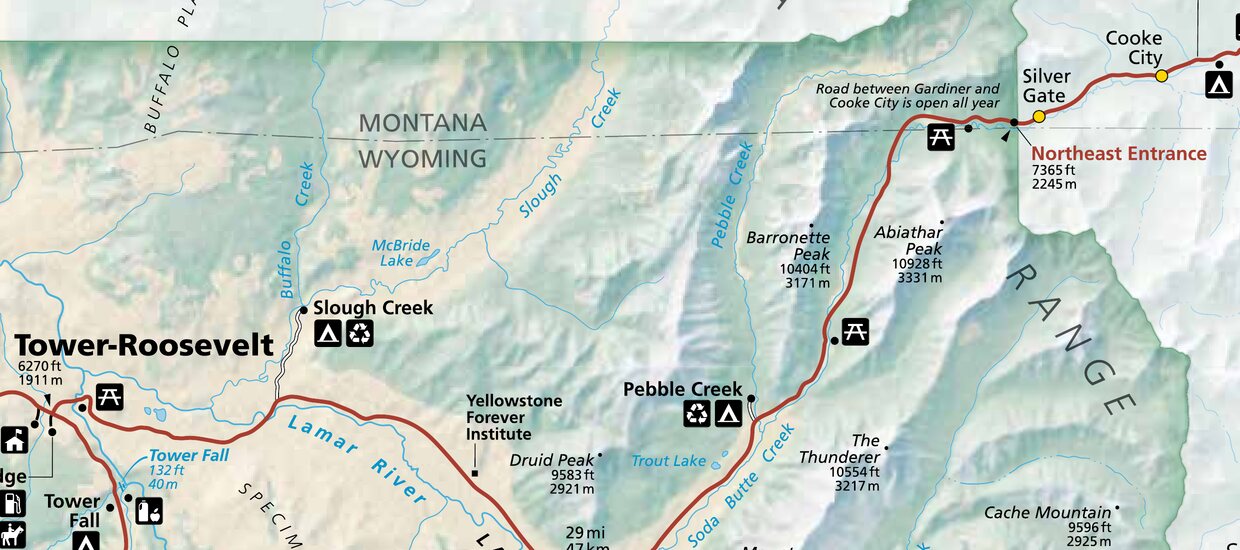
These are the eleven features Yellowstone names along the road from Tower Junction to the Northeast Entrance, in the park's wording. A stop whose name is not on this list is not a name the park uses.
| Stop, as the park names it | What it is | Species the park ties to it | Car access in winter |
|---|---|---|---|
| Lamar Valley | The northern range's open valley; the road runs its length | Bison year-round; wolves; coyotes common | Open — on the year-round road |
| Lamar Canyon | A named canyon on the same road, where the valley narrows | — | Open |
| Pleasant Valley | Named valley; site of "Uncle John" Yancey's Pleasant Valley Hotel, built 1884–1893 | — | Open |
| Specimen Ridge | Holds the largest concentration of petrified trees in the world, on the hillside east of Tower Junction | — | Roadside view year-round; the trail is summer and autumn only |
| Soda Butte | Hydrothermal feature, listed by the park with Calcite Springs | Bighorn sheep — named above Soda Butte | Open |
| Lamar Buffalo Ranch | Early 20th-century ranch; four buildings on the National Register of Historic Places | Bison history, not a viewing site | Drive past only — no facilities open to the public |
| Slough Creek Campground | Park campground on the Northeast road | — | Closed in winter |
| Pebble Creek Campground | 27-site campground beside its namesake creek | — | Closed in winter |
| Trout Lake Trail | Day hike off the Northeast road | — | Open — the only trail the park labels Northeast with a winter season |
| Slough Creek Trail | Day hike from the Slough Creek trailhead | — | Summer and autumn only |
| Garnet Hill Trail (Tower Junction) | Four- to five-hour day hike at Tower Junction | — | Open |
The Bannock Trail crosses this country. One fork ascends the Lamar River and splits at Soda Butte Creek before leaving the park, and the park notes that traces of it can still be plainly seen, particularly on the Blacktail Plateau and at the Lamar–Soda Butte confluence.
In summer this is a road of parked cars. In winter it is not, but the park's driving advice still holds: expect longer than usual driving times and expect wildlife on the roadway.
When the road lets you in
One road in Yellowstone is generally open year-round to regular vehicles: from the North Entrance at Gardiner, Montana, through the park to Cooke City, Montana, by way of Tower Junction. The Lamar Valley road is that road. Most of the rest closes to cars from early November to late April and runs oversnow — commercially guided snowcoach and snowmobile only — from mid-December to mid-March.
| Segment | Opens | Closes |
|---|---|---|
| North Entrance to Northeast Entrance, Gardiner to Cooke City via Tower Junction | Open year-round to regular vehicles | — |
| Mammoth Hot Springs to Norris | 15 December 2026 | 7 March 2027 |
| Norris to Madison; Norris to Canyon Village; Canyon Village to Washburn Hot Springs Overlook | 15 December 2026 | 9 March 2027 |
| Canyon Village to Fishing Bridge | 15 December 2026 | 14 March 2027 |
| West, South and East entrances, and all remaining groomed roads | 15 December 2026 | 15 March 2027 |
Two roads outside the Northeast Entrance change how Cooke City is reached. The Beartooth Highway (US-212) from Cooke City to Red Lodge is closed for the season, and typically opens on the Friday of Memorial Day weekend and closes in mid-October. The Chief Joseph Scenic Byway (WY-296) has 9 miles closed to wheeled vehicles in winter, oversnow travel only, from Cooke City to Pilot Creek, and is open to wheeled vehicles from mid-May to early November. In January, in other words, Cooke City and Silver Gate are reached by car from Gardiner, not from Cody.
The rest of the park reopens to cars in stages in 2027: the West Entrance to Madison, Madison to Old Faithful, Madison to Norris, Mammoth to Norris and Norris to Canyon on 16 April; the East Entrance to Fishing Bridge over Sylvan Pass and Canyon to Bridge Bay on 7 May; the South Entrance to West Thumb, West Thumb to Old Faithful over Craig Pass, West Thumb to Lake Village and Tower-Roosevelt to Tower Fall on 14 May; and Canyon to Tower Fall over Dunraven Pass, with the Beartooth and Chief Joseph highways, on 28 May, closing again on 11 October. Roads open at 8:00 a.m. on the first day of the season and are not gated at night.
Watching from the road: the rules that matter here
Two distances govern everything. Stay at least 100 yards (91 m) from bears, wolves and cougars, and at least 25 yards (23 m) from every other animal, bison and elk included. Approaching on foot inside those distances is prohibited, not merely discouraged. The park's shorthand for photographers is to zoom with the lens, not with the feet, and its test for whether you are too close is simple: if you cause an animal to move, you are too close.
In a valley where animals stand beside the road, the car is the viewing platform. Park in a roadside pullout rather than on the roadway, do not block traffic, and stay with your vehicle when traffic backs up. When watching bears, stay in or next to the car; if a bear approaches or touches the car, honk the horn and drive away. Rangers close roadside pullouts where visitors have been pushing the distances, so the pullout you planned to use may not be there.
It is illegal to willfully remain near or approach wildlife of any kind, birds included, within any distance that disturbs or displaces it. Drones are prohibited throughout the park. Carry bear spray even for a road stop — all of Yellowstone is bear habitat, and a pullout puts you out of the car. Early morning and evening are when animals feed and are easiest to see, and wolves peak at dawn and dusk in winter as they do in summer.
Lamar Valley weather, month by month
Lamar Ranger Station, on the valley floor at 6,575 ft, averages a January high of 26.5 °F (-3.1 °C) and low of 1.2 °F (-17.1 °C), and a July high of 81.6 °F (27.6 °C) and low of 41.5 °F (5.3 °C); the annual mean high is 52.4 °F and mean low 22.3 °F. (NOAA/NCEI U.S. Climate Normals 1991-2020, station USC00485355.)
| Month | Mean high °F | Mean high °C | Mean low °F | Mean low °C |
|---|---|---|---|---|
| January | 26.5 | -3.1 | 1.2 | -17.1 |
| February | 31.2 | -0.4 | 4.7 | -15.2 |
| March | 40.5 | 4.7 | 12.9 | -10.6 |
| April | 49.9 | 9.9 | 24.0 | -4.4 |
| May | 60.3 | 15.7 | 32.0 | 0.0 |
| June | 69.3 | 20.7 | 37.1 | 2.8 |
| July | 81.6 | 27.6 | 41.5 | 5.3 |
| August | 80.2 | 26.8 | 39.0 | 3.9 |
| September | 70.9 | 21.6 | 33.3 | 0.7 |
| October | 53.9 | 12.2 | 25.5 | -3.6 |
| November | 37.5 | 3.1 | 13.0 | -10.6 |
| December | 27.0 | -2.8 | 2.9 | -16.2 |
| Annual | 52.4 | 11.3 | 22.3 | -5.4 |
December, January and February are the only months whose average high stays below freezing; every month except June, July, August and September averages a low at or below freezing. A July afternoon averages 55 °F warmer than a January one.
The park's own Monthly Averages table (nps.gov/yell/planyourvisit/weather.htm) reads 28.6/9.6 °F for January and 79.6/46.7 °F for July, but that table names no station and the page's weather widget is set to Mammoth Hot Springs (44.9763, -110.6986), so it is Mammoth's series, not Lamar's.
Snow on the ground, month by month
Snow cover at valley elevation, from the nearest station that publishes snow normals — Tower Falls, 9.2 mi (14.8 km) west-northwest of Lamar Ranger Station and about 300 ft (91 m) lower: snow at least 1 in deep lies on the ground on 100% of January days, 96% of December days, 90% of March days, 43% of April days, 6% of May days and 0% of July and August days (NOAA/NCEI 1991-2020 daily normals, USC00489025). May and October rest on only 4 and 18 days of record.
| Month | Share of days | Typical depth on days with snow |
|---|---|---|
| January | 100.0% | 14.9 in |
| February | 99.9% | 18.7 in |
| March | 89.9% | 16.8 in |
| April | 42.7% | 8.4 in |
| May | 6.2% | 4.0 in — 4 days of record |
| June | 0.3% | — |
| July | 0.0% | — |
| August | 0.0% | — |
| September | 1.4% | — |
| October | 15.8% | 2.5 in — 18 days of record |
| November | 61.9% | 3.7 in |
| December | 96.3% | 8.6 in |
That cover is why the road question has two different answers. The valley road itself does not close: the North Entrance to Northeast Entrance road, Gardiner to Cooke City by way of Tower Junction, stays open to regular vehicles all winter, as the oversnow table above shows. The rest of the park's roads close to regular vehicles in early November and run oversnow from 15 December 2026 to 7, 9, 14 or 15 March 2027 by segment, with regular vehicles returning in stages between 16 April and 28 May 2027. The valley's own winter season — the guided winter tours that work it — is dated 17 December 2026 to 6 March 2027.
What a winter day here is actually like
In January and February the valley is cold, the light comes late and leaves early, and the day is a road day: you drive in from Gardiner or Cooke City, stop where the animals are, and run the heater between stops.
The certainties are bison and coyote. Bison winter on the northern range in their thousands and graze the flats either side of the road; coyotes work the open meadows through the middle of the day. Wolves are the reason many people come, and the northern range is genuinely one of the best places in the world to watch them, but a sighting is luck on the day rather than a scheduled stop. Elk, pronghorn, moose and both bear species are not part of the midwinter picture — grizzlies reappear from early February, black bears after the late-March thaw, elk and pronghorn on their own summer timetable.
A July visit is a different valley: pronghorn and elk on the flats, black bears in the Tower and Mammoth country, light until late evening, and traffic. If you want that version, start with the best time to visit Yellowstone and the seasonal guide; if you want the winter version, the road dates above are the whole plan.
Getting to the valley in winter
Gardiner sits at the North Entrance, on the year-round road. The park's own average drive times, published on a page it last updated in August 2025, are 15 minutes from the North Entrance to Mammoth Hot Springs, 40 minutes from Mammoth to Tower Junction, and 60 minutes from Tower Junction to the Northeast Entrance — and the park warns that wildlife on the roadway, weather and road projects can make each of them significantly longer. On this road that is the normal case, not the exception.
There is no second way in on a January morning. The West Entrance road at West Yellowstone and the South Entrance road at Jackson are oversnow only from 15 December 2026 to 15 March 2027, so a car arrives at the North Entrance or not at all. Cooke City and Silver Gate sit at the Northeast Entrance and are reached by car from Gardiner, because the Beartooth Highway is closed for the season and the last 9 miles of the Chief Joseph Scenic Byway are oversnow only. Getting to Yellowstone covers the approach roads, and Yellowstone road closures has the seasonal status of each one.
Four things to settle before you drive in
- Be on the road at first light or stay until dusk: bison and coyote show all day, wolves do not.
- Eat before you go — the Lamar Buffalo Ranch has no facilities open to the public, and both campgrounds on the road are closed for the winter.
- Take bear spray even if you never leave the car — the stops put you outside it.
- Check the Chief Joseph and Beartooth status before planning a Cooke City loop; neither takes a wheeled vehicle in January.
Summer wildlife tours into the valley
Three operators publish a guided trip into the valley, and they are not comparable products: one is a scheduled bus out of a park lodge, the other two are private full-day tours charged by the day or by the party. The table is the at-a-glance answer — the rate, what the rate is charged for, how many people it covers and the season it belongs to — and the paragraphs under it carry each operator's own published detail, dated to the day the page was read.
| Tour and operator | Rate | Charged | Party size | Season |
|---|---|---|---|---|
| Wake Up To Wildlife — Yellowstone National Park Lodges (Xanterra) | $139.98 per adult, $69.99 per child 3-11, under 3 free; taxes and fees included | Per person | Scheduled bus; no party size published | 2027: Mammoth Hot Springs Hotel, May 8 - Oct 9; Roosevelt Lodge, Jun 5 - Sep 5 |
| Lamar Valley Wildlife Tour — Yellowstone Guidelines | $850 per day for 1-2 people, $900 per day for 3-4, $75 for each additional person | Per day, not per person | 1-2, 3-4, then each additional person | No season stated; rate undated on the operator's page |
| Yellowstone Wolves & Wildlife — Yellowstone Wildlife Profiles | From $875 for 1-2 guests; $905 for 3 guests; $1,280 for 14 | Total for the entire party | 1-2 guests up to 14 | No season stated; rate undated on the operator's page |
Wake Up To Wildlife, 2027
Wake Up To Wildlife, Yellowstone National Park Lodges (Xanterra), 2027: $139.98 per adult and $69.99 per child 3-11, under 3 free, taxes and fees included. Mammoth Hot Springs Hotel, May 8 - Oct 9, 2027, check-in 6:15 am (May 8 - Jul 31), 6:30 am (Aug 1-31), 6:45 am (Sep 1-14), 7:00 am (Sep 15 - Oct 9). Roosevelt Lodge, Jun 5 - Sep 5, 2027, check-in 7:00 am (Jun 5 - Jul 31) and 7:15 am (Aug 1 - Sep 5). The bus leaves the Mammoth/Roosevelt area before dawn and heads for Lamar Valley; gratuities are not included and no page states whether park entry is.
Yellowstone Guidelines, private full day
Yellowstone Guidelines runs a private full-day Lamar Valley tour, published rate (undated on the operator's page, read 16 Nov 2026): $850 per day for 1-2 people, $900 per day for 3-4, $75 for each additional person — all rates are daily, not per person. Expect around 7 to 8 hours; hotel pickup, viewing scope, binoculars and lunch are included, park entrance fee and guide gratuity are not. Licensed by the National Park Service, CUA13-063.
Yellowstone Wildlife Profiles, private full day
Yellowstone Wildlife Profiles runs a private full-day Yellowstone Wolves & Wildlife tour from $875 for a party of 1-2 guests (published rate, undated on the operator's page, read 16 Nov 2026); rates are total for the entire party, rising to $905 for 3 guests and $1,280 for 14. Expect 7-9 hours with a sunrise start, usually into the Lamar Valley. Park entry is not included; pickup at Canyon Village adds $100.
Two of the three rates are undated on the operator's page: the read date in the table is the only date they carry, and they are the numbers to re-check before booking.
For the species themselves, the Yellowstone wildlife guide covers bears, wolves and bison across the whole park, and the wildlife tours and photography guide covers the guided options and the light.