Yellowstone History: 11,000 Years from Native Americans to National Park
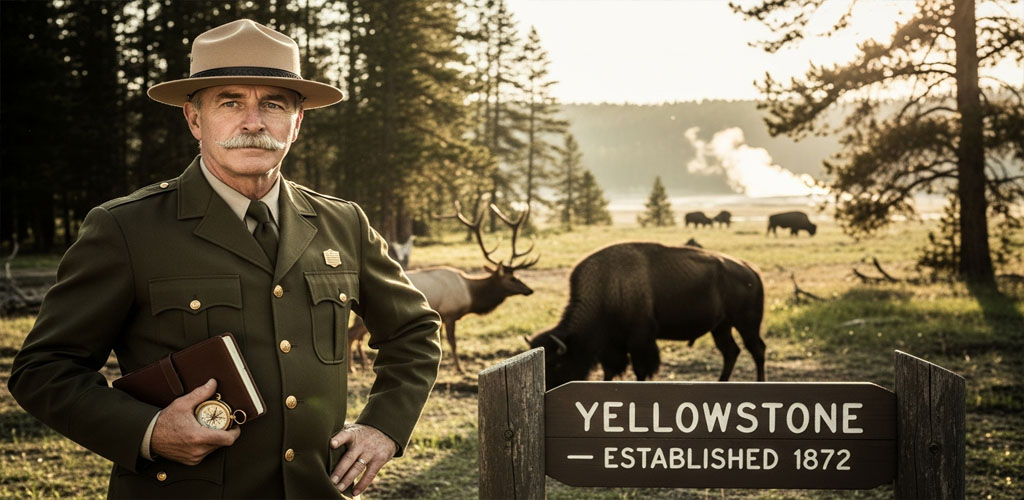
Yellowstone's rich history spans over 11,000 years, from ancient Native American civilizations to becoming the world's first national park in 1872. This comprehensive historical journey reveals how indigenous peoples, mountain men, explorers, and visionary leaders shaped America's most iconic natural preserve into the conservation model that protects wilderness ecosystems worldwide.
⏰ Quick History Timeline
- 11,000+ years ago: First Native American inhabitants arrive
- 3,000-1,500 years ago: Peak of Native American activity
- 1807-1808: John Colter becomes first European American to explore region
- 1869-1871: Three major expeditions map and document Yellowstone
- March 1, 1872: President Grant signs bill creating world's first national park
- 1886-1918: U.S. Army manages park for 32 years
- 1916: National Park Service created
Native American Heritage: The Original Stewards (11,000+ Years Ago - 1800s)
Ancient Inhabitants and Sacred Landscapes
Long before European explorers dreamed of Yellowstone's existence, Native American peoples had lived, hunted, and conducted ceremonies in this remarkable landscape for over 11,000 years. Archaeological evidence reveals a continuous human presence that predates the oldest Egyptian pyramids, with the peak of activity occurring during the Late Archaic period between 3,000 and 1,500 years ago.
For these indigenous peoples, Yellowstone was never wilderness—it was home. Multiple tribes knew this land by names that reflected its unique character: "land of the geysers," "land of the burning ground," "the place of hot water," "land of vapors," and "many smoke." These names reveal an intimate understanding of Yellowstone's geothermal features that European science would not achieve for centuries.
🏔️ Associated Tribal Nations
- Tukudika (Sheep Eaters): Mountain Shoshone band, year-round residents living in high elevations
- Shoshone: Seasonal hunters and gatherers with deep spiritual connections to the land
- Crow (Apsáalooke): Occupied areas generally east of present-day park boundaries
- Blackfeet (Siksiká): Controlled territories to the north, with 18,000-year genetic heritage
- Nez Perce (Nimíipuu): Traversed park during seasonal migrations
- Bannock: Closely related to Shoshone, shared hunting and gathering territories
- Kiowa: Oral histories place ancestors in region from 1400-1700 CE during Little Ice Age
Sophisticated Seasonal Life and Trade Networks
The Tukudika, or Sheep Eaters, represent the most remarkable example of year-round mountain dwelling in North America. These Mountain Shoshone developed sophisticated survival strategies for Yellowstone's harsh winters, living at elevations that challenged even modern visitors. They created intricate hunting tools, including distinctive sheep horn bows prized for their power and accuracy, and developed detailed knowledge of seasonal plant and animal cycles.
Yellowstone served as a crucial hub in extensive Native American trade networks that spanned the continent. Obsidian from Yellowstone's Obsidian Cliff has been discovered in archaeological sites as far east as Ohio and Ontario, Canada, demonstrating the park's importance in prehistoric commerce. This black volcanic glass was prized for its sharp edges and worked into tools, weapons, and ceremonial objects that carried Yellowstone's essence across thousands of miles.
🌿 Traditional Land Use Practices
- Seasonal Hunting: Strategic harvesting of elk, deer, and mountain sheep during optimal times
- Plant Gathering: Collection of camas, bitterroot, and medicinal plants in sustainable cycles
- Ceremonial Activities: Sacred rituals conducted near geothermal features
- Trail Networks: Established routes that later became explorers' and settlers' paths
- Resource Management: Sustainable practices that maintained ecosystem balance for millennia
Native American oral traditions preserve rich knowledge about Yellowstone's natural phenomena, including detailed observations of geyser patterns, wildlife behavior, and seasonal changes. These traditions, documented in Peter Nabokov and Lawrence Loendorf's 2004 study "Restoring a Presence," reveal sophisticated understanding of complex ecological relationships that modern science has only recently begun to appreciate.
Mountain Men Era: European Discovery and Tall Tales (1807-1860s)
John Colter: The First European American Explorer
The first documented European American to witness Yellowstone's wonders was John Colter, a member of the Lewis and Clark Expedition who chose adventure over returning to civilization. In the winter of 1807-1808, Colter embarked on an extraordinary solo journey through what would become Yellowstone and Grand Teton National Parks, surviving harsh mountain conditions that would challenge modern winter adventurers.
Colter's route likely took him past thermal features like Mud Volcano, though he apparently missed Old Faithful and Grand Prismatic Spring. His reports of boiling springs and steaming landscape earned the region the nickname "Colter's Hell," though this term originally referred to thermal areas along the Shoshone River near present-day Cody, Wyoming, rather than Yellowstone itself.
⛰️ Famous Mountain Men of Yellowstone
- John Colter (1807-1808): First European American explorer, winter survival legend
- Jim Bridger (1820s-1840s): Master storyteller whose "tall tales" contained surprising truth
- Thomas Fitzpatrick: Renowned guide and trapper who helped open western routes
- Jedediah Smith: Evangelical explorer who mapped vast wilderness territories
- Osborne Russell: Most accurate chronicler of early Yellowstone experiences
- Manuel Lisa: Spanish trader who established Fort Manuel at Big Horn mouth
Jim Bridger: Tall Tales with Hidden Truths
Perhaps no figure captures the mountain man era better than Jim Bridger, whose seemingly outrageous stories about Yellowstone contained more truth than contemporary listeners believed. Bridger regaled audiences with tales of "glass mountains" (obsidian cliffs), geysers spouting water 70 feet into the air (accurate descriptions of various geysers), and "petrified forests with petrified birds singing petrified songs" (the actual Petrified Tree areas).
These colorful descriptions, while embellished for entertainment, preserved accurate observations of Yellowstone's unique features. Bridger's reputation for storytelling initially hindered scientific acceptance of Yellowstone's wonders, as educated audiences dismissed his reports as frontier exaggeration. Only later expeditions would vindicate many of his seemingly impossible claims.
Osborne Russell provided the most reliable early documentation of Yellowstone, visiting the area at least three times and keeping detailed journals. His writings offer glimpses into the abundant wildlife, pristine landscapes, and challenging travel conditions that characterized the region before official exploration and development.
Scientific Exploration: Mapping the Wonderland (1869-1871)
The Three Great Expeditions
Yellowstone's transition from mystery to mapped territory occurred through three crucial expeditions that combined scientific rigor with adventurous spirit. These explorations laid the foundation for Yellowstone's establishment as a national park by providing credible documentation of its extraordinary features.
🗺️ The Expedition Trilogy
- Cook-Folsom-Peterson Expedition (1869): First formal civilian exploration with scientific goals
- Washburn-Langford-Doane Expedition (1870): Comprehensive reconnaissance with military escort
- Hayden Geological Survey (1871): Government-sponsored scientific expedition that convinced Congress
The Hayden Survey: Photography and Art Change History
The most influential exploration was Ferdinand Vandeveer Hayden's 1871 Geological Survey, which transformed public perception of Yellowstone through groundbreaking documentation. Hayden assembled a team of 34 men including photographer William Henry Jackson and artist Thomas Moran, whose visual records would prove instrumental in convincing Congress to protect the region.
Jackson's photographs provided the first visual proof of Yellowstone's wonders to skeptical Eastern audiences, while Moran's paintings captured the area's sublime beauty in vivid colors that black-and-white photography could not convey. These artistic and scientific records overcame the credibility problems that had plagued mountain men's stories, offering undeniable evidence of Yellowstone's extraordinary character.
📸 Visual Documentation Impact
- William Henry Jackson: First photographs of geysers, hot springs, and canyon features
- Thomas Moran: Dramatic paintings emphasizing Yellowstone's artistic and spiritual value
- Henry Elliott: Detailed sketches supplementing photographic record
- Scientific Journals: Hayden's meticulous observations and geological analysis
- Media Coverage: Newspaper articles and magazine features reaching national audiences
The expedition's scientific findings revealed Yellowstone's global significance as a geological laboratory containing rare and extraordinary natural phenomena. Hayden's team documented geyser mechanics, mapped thermal features, catalogued wildlife populations, and analyzed the unique geological forces that created this remarkable landscape.
Birth of the National Park Idea (1872)
Congressional Debate and Protection Act
The concept of preserving Yellowstone as a public park faced significant opposition in an era when federal policy favored transferring public lands to private ownership. However, the documented evidence from the Hayden Survey, combined with lobbying efforts by expedition members and visionary conservationists, gradually built Congressional support for an unprecedented conservation experiment.
The debate reflected broader tensions about federal authority, states' rights, and the proper use of public lands. Supporters argued that Yellowstone's unique features made it unsuitable for traditional development while possessing tremendous value for public education and enjoyment. Opponents questioned federal spending on seemingly impractical "pleasuring-grounds" when the nation faced pressing economic challenges.
⚖️ The Historic Yellowstone Act of 1872
Signed: March 1, 1872, by President Ulysses S. Grant
Size: Approximately 2 million acres spanning Wyoming, Montana, and Idaho
Purpose: "Dedicated and set apart as a public park or pleasuring-ground for the benefit and enjoyment of the people"
Protection Mandate: Preserved "from injury or spoilation, of all timber, mineral deposits, natural curiosities, or wonders within"
Global First: World's first national park, creating a new model for conservation
Vision and Early Challenges
The Yellowstone Act established an revolutionary principle: that extraordinary natural areas belonged to all Americans rather than individual property owners. This democratic vision challenged prevailing attitudes about land ownership and resource extraction, creating a new category of public space dedicated to preservation and education.
However, the Act provided no funding for park management, leaving Yellowstone vulnerable to vandalism, commercial exploitation, and inadequate protection. Early superintendents struggled with limited resources, unclear authority, and the immense challenge of managing a wilderness area larger than some states.
Army Management: Military Discipline Saves the Park (1886-1918)
From Chaos to Order
By the 1880s, Yellowstone faced a crisis. Civilian management had proven inadequate to protect the park from poachers, vandals, and commercial exploitation. Wildlife populations declined dramatically, thermal features suffered damage from souvenir hunters, and unauthorized development threatened the park's wilderness character.
In 1886, Congress transferred Yellowstone management to the U.S. Army, beginning a 32-year period of military administration that saved the park from destruction. Army officers brought military discipline, organizational expertise, and enforcement capabilities that civilian superintendents had lacked.
🪖 Army Achievements (1886-1918)
- Wildlife Protection: Ended commercial poaching and began population recovery
- Infrastructure Development: Built roads, facilities, and visitor services
- Law Enforcement: Established effective patrol and protection systems
- Scientific Management: Initiated systematic wildlife and resource studies
- Professional Standards: Created management protocols still used today
- Public Access: Balanced protection with visitor accommodation
Transportation Revolution and Visitor Growth
The railroad's arrival in 1883 at Livingston, Montana, dramatically improved Yellowstone access, reducing the journey from days of difficult travel to comfortable rail transport. This transportation revolution brought increasing numbers of visitors while raising new questions about balancing public access with wilderness preservation.
In 1915, automobiles were allowed into Yellowstone for the first time, democratizing park access and making visits more affordable for middle-class families. This automotive access represented another transportation revolution that would fundamentally reshape national park tourism throughout the 20th century.
National Park Service Era: Professional Conservation (1916-Present)
Creating America's Conservation Agency
The establishment of the National Park Service in 1916 reflected growing recognition that America's national parks required specialized, professional management. The new agency inherited Yellowstone and other protected areas from various departments, creating unified administration under a clear conservation mandate.
The 1916 Organic Act defined the Park Service mission "to conserve the scenery and the natural and historic objects and the wild life therein and to provide for the enjoyment of the same in such manner and by such means as will leave them unimpaired for the enjoyment of future generations." This balanced mandate continues to guide park management today.
🌍 Yellowstone's Global Legacy
- International Model: Inspired creation of 4,000+ protected areas worldwide
- UNESCO Recognition: World Heritage Site designation in 1978
- Biosphere Reserve: International recognition for ecosystem conservation
- Conservation Science: Research advances benefiting global conservation
- Management Innovation: Pioneering approaches to wilderness protection
- Educational Impact: Inspiring environmental awareness worldwide
Modern Conservation Challenges and Achievements
Yellowstone's history continues evolving as modern challenges require innovative solutions. Climate change, increasing visitation, ecosystem management, and balancing conservation with public access represent ongoing challenges that build upon 150+ years of management experience.
Successful conservation achievements include the restoration of wolf populations, recovery of several endangered species, advanced ecosystem research, and development of sustainable tourism practices that support both conservation and local communities. These achievements demonstrate the enduring value of the national park concept that began in Yellowstone.
Archaeological and Cultural Preservation
Protecting 11,000 Years of Heritage
Modern Yellowstone management recognizes the importance of preserving cultural as well as natural heritage. Over 1,000 archaeological sites document the long history of human presence, while 1,106 historic structures protect the architectural legacy of park development.
📚 Historical Resources
- Archaeological Sites: 1,000+ documented locations preserving Native American heritage
- Historic Buildings: 1,106 structures representing various management eras
- National Historic Landmarks: 5 designated sites including Obsidian Cliff
- Museum Collections: Artifacts, documents, and photographs preserving park history
- Oral History Projects: Recording stories from tribal members and long-time residents
Contemporary efforts emphasize collaboration with tribal nations to ensure accurate representation of Native American history and ongoing cultural connections to Yellowstone. These partnerships recognize that Yellowstone's story begins thousands of years before European contact and continues through living tribal traditions today.
Historical Significance: Yellowstone's 153-year history as a national park represents humanity's first systematic attempt to preserve wilderness ecosystems for future generations. From Native American stewardship through modern conservation science, this history demonstrates evolving understanding of the relationship between human societies and natural systems.
For contemporary park information and planning your historical exploration of Yellowstone, visit our Trip Planning Guide and Visitor Centers which feature historical exhibits and educational programs.