Yellowstone Volcano: Understanding America's Supervolcano Activity & Current Status
Beneath Yellowstone National Park lies one of Earth's most closely monitored volcanic systems—a supervolcano that has shaped the landscape and continues to power the park's extraordinary geothermal features. While media coverage often sensationalizes volcanic activity at Yellowstone, scientific evidence provides a much more measured and fascinating picture of this geological giant. Understanding Yellowstone's volcanic nature enhances both safety and appreciation for this remarkable natural system.
🌋 Current Status Alert (September 2025)
Volcanic Alert Level: Normal (Background Activity)
Aviation Color Code: Green
Last Major Eruption: 630,000 years ago
Recent Activity (August 2025): 94 earthquakes recorded, largest magnitude 3.7
Next Expected Eruption: Likely thousands of years in the future
The Yellowstone Supervolcano: Scale and Significance
Yellowstone qualifies as a "supervolcano" due to its massive caldera and eruption history. The current Yellowstone Caldera spans 60 kilometers (35 miles) across, formed during the most recent major eruption 630,000 years ago. This volcanic system ranks among the world's largest, with a magma chamber containing an estimated 400-500 cubic kilometers of molten and semi-molten rock.
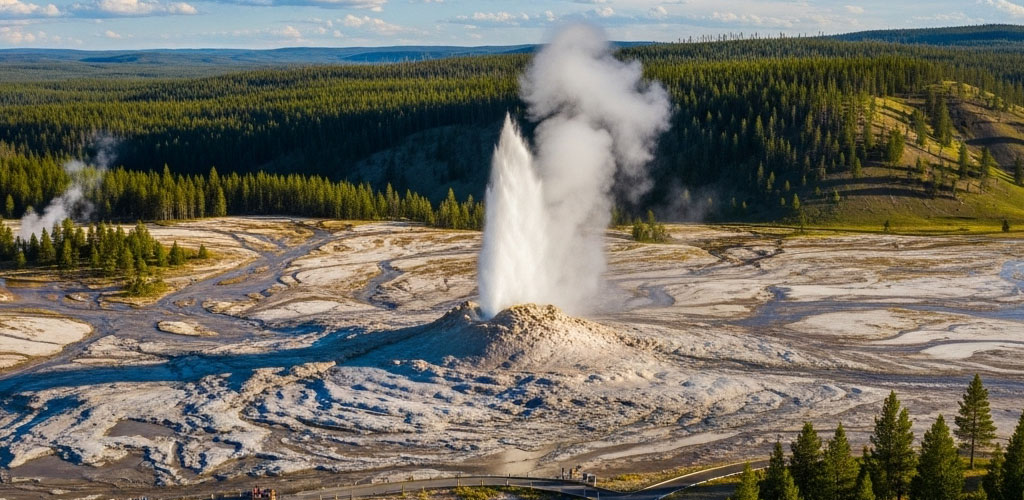
What makes Yellowstone particularly fascinating is its ongoing activity. Unlike dormant volcanoes that show no signs of life, Yellowstone's volcanic system continuously demonstrates its presence through more than 10,000 geothermal features—geysers, hot springs, fumaroles, and mud pots that collectively represent the largest concentration of such features anywhere on Earth.
Understanding the Magma Chamber
Recent scientific research, including a groundbreaking January 2025 study published in Nature, has revealed unprecedented details about Yellowstone's underground magma system. Using electrical conductivity mapping, scientists have created three-dimensional images showing that the upper magma chamber resembles a "gigantic frying pan" with dimensions of 19 miles from northwest to southeast and 55 miles from southwest to northeast.
This enormous underground reservoir sits at depths of 3-9 miles beneath the surface, with a northeastern "handle" extending 10 miles beyond the caldera boundary. Importantly, seismic imaging indicates that this massive chamber is mostly solid—a crucial factor in assessing volcanic risk.
🔬 Scientific Monitoring Facts
- Monitoring Network: 26 seismic stations, 16 GPS stations
- Data Collection: Real-time and near real-time monitoring
- Advanced Detection: Machine learning identifies 10x more seismic events
- Historical Database: 86,276 earthquakes catalogued from 2008-2022
- Partnership Organizations: USGS, NPS, University of Utah, Wyoming, UNAVCO
Yellowstone's Volcanic History: Patterns and Cycles
Yellowstone's volcanic record reveals a pattern of major eruptions occurring approximately every 600,000-800,000 years. Three massive "supereruptions" have occurred over the past 2.1 million years:
The Huckleberry Ridge Eruption (2.1 Million Years Ago)
This first supereruption created the Island Park Caldera, ejecting approximately 2,500 cubic kilometers of material. The eruption was so massive that volcanic ash deposits from this event have been found across much of the western United States.
The Mesa Falls Eruption (1.3 Million Years Ago)
The second major eruption produced the Henry's Fork Caldera, releasing about 280 cubic kilometers of material. While smaller than the first eruption, this event still ranked as one of the largest volcanic eruptions in Earth's recent geological history.
The Lava Creek Eruption (630,000 Years Ago)
The most recent supereruption created the current Yellowstone Caldera and ejected approximately 1,000 cubic kilometers of material. This eruption's ash deposits have been found from California to Missouri, demonstrating the continental scale of such events.
Smaller Eruptions and Ongoing Activity
Between these major eruptions, Yellowstone has experienced numerous smaller volcanic events. The most recent significant eruption occurred about 70,000 years ago, producing lava flows rather than explosive activity. Scientists emphasize that this pattern of smaller eruptions is much more likely to represent future volcanic activity than another supereruption.
Current Volcanic Monitoring: The Yellowstone Volcano Observatory
The Yellowstone Volcano Observatory (YVO), established in 2001, represents one of the most sophisticated volcanic monitoring systems in the world. This partnership between multiple federal and state agencies provides continuous surveillance of one of Earth's most significant volcanic systems.
Advanced Monitoring Technology
YVO employs cutting-edge technology to monitor multiple indicators of volcanic activity:
Seismic Monitoring: A network of 26 seismic stations continuously records earthquake activity throughout the Yellowstone region. Recent advances in machine learning have dramatically improved detection capabilities, identifying approximately 10 times more seismic events than previously recorded.
Ground Deformation: GPS stations and satellite interferometry detect minute changes in ground elevation that might indicate magma movement. The Yellowstone caldera undergoes periodic uplift and subsidence cycles, which scientists carefully track for patterns.
Gas Emission Analysis: Scientists monitor volcanic gas emissions, particularly carbon dioxide and sulfur dioxide, which can indicate changes in magma chamber activity. Yellowstone releases approximately 45,000 tons of carbon dioxide annually through natural processes.
Thermal Monitoring: Satellite and ground-based thermal imaging tracks temperature changes in geothermal features, which could signal changes in underlying volcanic processes.
📊 Recent Seismic Activity (August 2025)
- Total Earthquakes: 94 recorded in Yellowstone region
- Largest Event: Magnitude 3.7 earthquake near West Yellowstone, Montana
- Event Details: August 19, 2025, 11:14 AM MDT
- Associated Activity: 4 foreshocks, 31 aftershocks recorded
- Assessment: Normal background seismic activity
Understanding Volcanic Risk: Facts vs. Fiction
Media coverage of Yellowstone's volcanic activity often creates unnecessary alarm. Scientific evidence provides a much more reassuring picture of actual volcanic risk:
Supereruption Probability
Despite popular concerns, the probability of a catastrophic supereruption at Yellowstone is extremely low. The U.S. Geological Survey estimates the annual probability of a supereruption at approximately 1 in 730,000—making it far less likely than many other natural disasters.
More Likely Scenarios
Scientists consider several scenarios much more probable than a supereruption:
Lava Flows: The most likely future eruption would involve relatively quiet lava flows, similar to those that occurred 70,000 years ago. Such eruptions would affect local areas but would not pose continental or global threats.
Hydrothermal Explosions: These steam-driven explosions occur when underground water rapidly converts to steam. While potentially dangerous locally, these events are unrelated to magma eruptions and occur with much greater frequency.
Continued Geothermal Activity: The most probable scenario involves continuation of current geothermal activity without major volcanic eruptions. This ongoing activity provides the spectacular features that make Yellowstone unique.
The Science Behind Yellowstone's Thermal Features
Yellowstone's volcanic system directly creates the park's extraordinary geothermal landscape. Understanding this connection helps visitors appreciate both the beauty and the underlying science of these features.
Heat Source and Distribution
The magma chamber beneath Yellowstone provides the heat that drives all geothermal activity. Groundwater seeps down through fractured rock until it contacts this heat source, becomes superheated, and returns to the surface as various thermal features.
Recent research shows that hot basalt magma rising from deep in the Earth's mantle continuously adds heat to the rhyolite magma chamber above. This ongoing process maintains the thermal energy that powers Yellowstone's geothermal system.
Different Types of Thermal Features
Geysers: Form when underground plumbing systems allow water to heat under pressure, then erupt when pressure is released. Yellowstone contains 55% of the world's geysers.
Hot Springs: Occur where heated water reaches the surface through more open channels, allowing continuous flow rather than explosive eruptions.
Fumaroles: Steam vents where underground water is so hot that it completely vaporizes before reaching the surface, releasing only steam and gases.
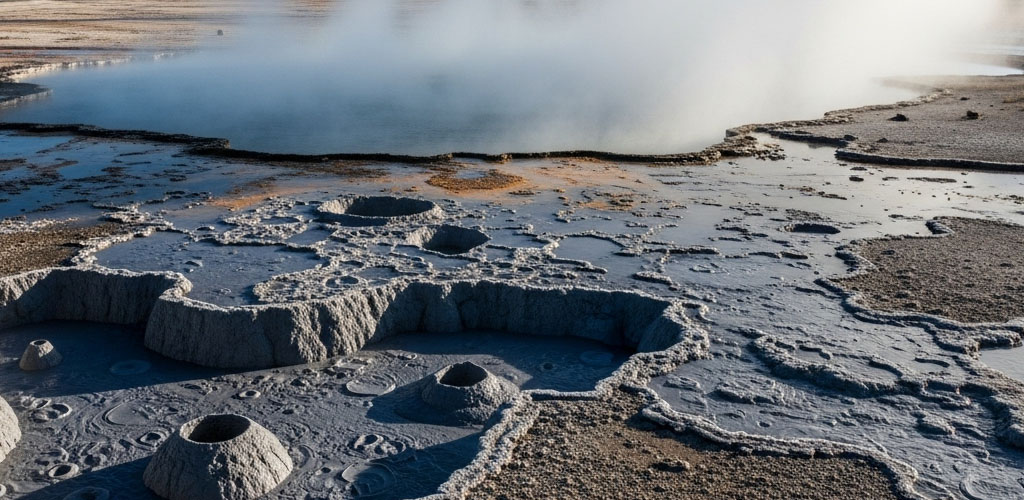
Mud Pots: Form where acidic volcanic gases break down surrounding rock into clay, creating bubbling pools of muddy water.
Volcanic Gases and Air Quality
Yellowstone's volcanic system continuously releases gases that occasionally affect local air quality. Understanding these emissions helps visitors plan safe and comfortable visits.
Common Volcanic Gases
The primary gases released include carbon dioxide, hydrogen sulfide (responsible for the "rotten egg" smell), and sulfur dioxide. While these gases are natural products of volcanic activity, they can reach concentrations that affect sensitive individuals.
Seasonal Patterns
Gas concentrations often increase during winter months when atmospheric conditions trap emissions in valleys. Visitors with respiratory sensitivities should be aware of current conditions and may want to avoid heavily thermal areas during high gas concentration periods.
🎯 Visitor Safety Around Volcanic Features
- Stay on Boardwalks: Thermal areas have unstable ground and dangerous temperatures
- Respect Barriers: All safety barriers exist for protection from volcanic hazards
- Monitor Air Quality: Check park alerts for gas emission warnings
- Emergency Awareness: Know locations of ranger stations and emergency phones
- Heat Hazards: Water temperatures often exceed 200°F (93°C)
Climate and Volcanic Activity Connections
Yellowstone's volcanic system interacts with climate in ways that affect both local weather patterns and global atmospheric conditions.
Local Climate Effects
Geothermal areas create unique microclimates throughout the park. Thermal features moderate local temperatures, allowing some vegetation to remain green throughout winter and creating habitat conditions not found elsewhere at similar elevations.
Global Climate Considerations
While a major Yellowstone eruption could affect global climate, current scientific consensus indicates such events are not anticipated in the foreseeable future. The ongoing geothermal activity has minimal global climate impact compared to other natural and human factors.
Future Research and Technological Advances
Scientific understanding of Yellowstone's volcanic system continues to advance through new research and technology.
Emerging Technologies
Researchers are developing new methods for monitoring volcanic systems, including improved seismic detection, advanced satellite monitoring, and chemical analysis techniques. Machine learning approaches have already dramatically improved earthquake detection capabilities.
International Collaboration
Yellowstone research contributes to global understanding of supervolcano systems. Scientists share data and techniques with colleagues studying similar systems worldwide, improving overall volcanic hazard assessment capabilities.
Planning Your Visit: Volcanic Awareness
Understanding Yellowstone's volcanic nature enhances visitor experience while promoting safety awareness.
Best Times for Thermal Feature Viewing
Winter visits offer dramatic contrasts between snow and steaming thermal features, while summer provides easier access to more remote geothermal areas. Spring and fall offer moderate crowds with good viewing conditions.
Photography Considerations
Volcanic features provide extraordinary photography opportunities. Early morning and late afternoon lighting enhance steam visibility, while winter conditions create particularly dramatic contrasts.
Educational Opportunities
Visitor centers provide current information about volcanic monitoring and research. Ranger-led programs often include discussions of Yellowstone's volcanic nature and ongoing scientific work.
📚 Staying Informed
- Official Updates: Yellowstone Volcano Observatory
- Real-time Data: USGS Volcano Hazards Program
- Park Information: Yellowstone National Park
- Scientific Papers: Follow latest research in volcanic journals
- Emergency Alerts: Sign up for park emergency notifications
Conservation and Research Support
Yellowstone's volcanic research contributes to global volcanic hazard mitigation and scientific understanding. Visitors can support this work through various programs.
Yellowstone Forever
The park's official nonprofit partner supports volcanic research and monitoring through various programs. Donations help fund equipment, research projects, and educational initiatives.
Citizen Science Opportunities
Some research projects welcome volunteer participation in data collection and analysis. These programs allow visitors to contribute directly to volcanic research while learning about scientific methods.
Yellowstone's volcanic nature represents one of the most fascinating and well-monitored geological phenomena on Earth. While the supervolcano captures public imagination, the reality involves careful scientific monitoring, extremely low near-term risk, and ongoing research that contributes to global volcanic science. Understanding this volcanic system enhances appreciation for Yellowstone's unique features while promoting informed awareness of natural processes that continue to shape our planet.
For the most current volcanic activity updates and scientific monitoring data, visit the Yellowstone Volcano Observatory and Yellowstone National Park official websites.