Hydrothermal Explosions in Yellowstone: Norris, Biscuit Basin, and What to Check Before You Walk
At 5:09 on the morning of 13 June 2026 the ground at Biscuit Basin threw steam, rock and near-boiling water into the air, and the Firehole River ran milky grey for six kilometres below it. Nobody was hurt: the basin had been closed to visitors since a larger explosion in the same spot two years earlier. Small hydrothermal explosions happen somewhere in Yellowstone almost every year, and the question that matters to a visitor is not whether the volcano is acting up. It is whether the basin you planned to walk is open.
What a hydrothermal explosion is
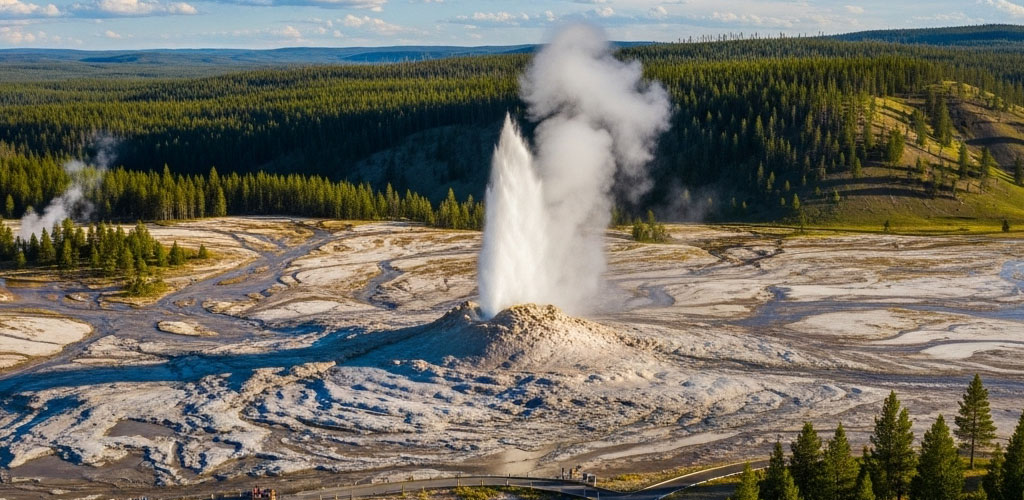
Yellowstone's heat comes from a magma reservoir kilometres below the surface, but a hydrothermal explosion is not a volcanic eruption. Groundwater percolating down is heated well past boiling point and held liquid by the pressure of the rock and water above it. When that water finds a route to the surface it flashes to steam, expands enormously in an instant, and breaks through the ground, throwing rock fragments, silica mud and near-boiling water a short distance.
The result is a crater a metre or two across, or in the largest prehistoric cases two kilometres across. Mary Bay, on the north shore of Yellowstone Lake, is the largest known hydrothermal explosion crater on Earth at 2.4 km (1.5 miles) across, and it formed about 13,000 years ago. The small ones are the ones that happen on a human timescale — almost every year somewhere in the park — and they can happen in a basin with a boardwalk through it.
Norris, 10 April 2025: the pool nobody saw form
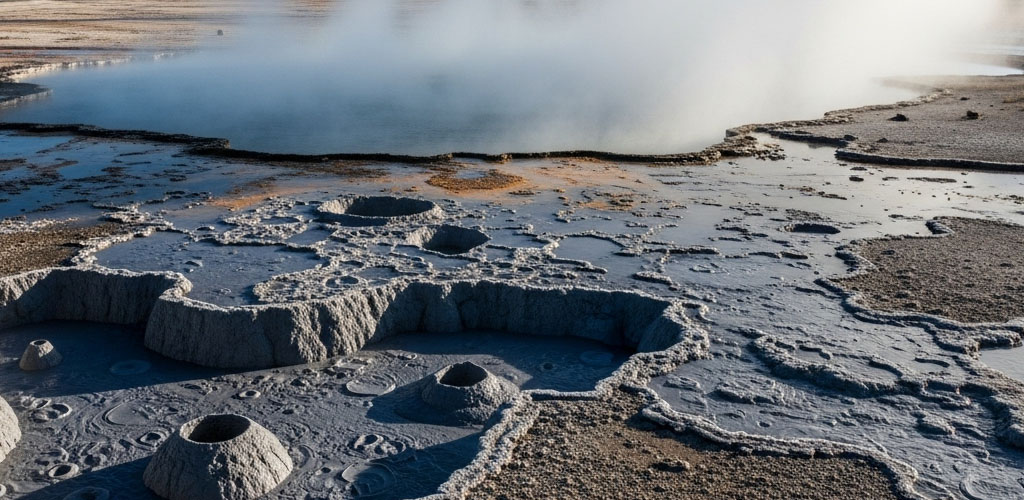
Park geologists were at Norris Geyser Basin on 10 April 2025 servicing temperature-logging stations — their first visit to the basin since the previous autumn — and found a pool that had not been there when they left.
| Feature | Measurement |
|---|---|
| Where | Porcelain Basin, immediately west of the vegetated patch known as Tree Island |
| Width | About 4 m (13 ft) across |
| Water temperature | About 43 °C (109 °F), light blue |
| Water level | About 30 cm (1 ft) below the rim of the pool |
| When it formed | Sometime between late December 2024 and early February 2025 |
Satellite imagery fixes the window more tightly. There was no feature west of Tree Island on 19 December 2024, a small depression had appeared by 6 January 2025, and the pool was fully formed by 13 February 2025. The basin's infrasound station recorded a weak acoustic signal from that direction on 25 December 2024 with no accompanying seismic signal, and the observatory's best estimate is that the feature began to form on Christmas Day 2024 — not in one violent event, but through a series of small ones that first threw rocks and later threw silica mud, leaving a pit that filled with hot water.
The earlier explosions at Norris
Norris has done this repeatedly. On 15 April 2024, at 2:56 p.m. local time, an explosion on Porcelain Terrace near the western edge of Nuphar Lake left a crater between one and two metres across, about 50 m (160 ft) from a boardwalk. Geologists found it the following month. The monitoring station installed in the basin in September 2023 recorded the acoustic signal and its direction, making it the first hydrothermal explosion in Yellowstone identified from geophysical data rather than from the ground afterwards.
The benchmark everyone compares against is older: Porkchop Geyser exploded in 1989, in an event that was observed closely enough to describe. That one and the 2024 crater are the two modern reference points for the basin.
Biscuit Basin, 13 June 2026
Just after 5:09 a.m. MDT on Saturday 13 June 2026, monitoring equipment in Biscuit Basin registered seismic energy and a low-frequency acoustic signal — infrasound — coming from the direction of Black Diamond Pool. A camera installed in May 2025 to watch that pool was pointing the right way.
| When | What happened |
|---|---|
| Just after 5:09 a.m., 13 June 2026 | Seismic and infrasound signals registered, from the direction of Black Diamond Pool |
| 5:09:50 a.m. MDT | The camera records a dark steam plume jetting out of the ground north of Black Diamond Pool |
| Morning of 13 June | The Firehole River runs light grey and milky from Biscuit Basin downstream to Midway Geyser Basin, about 6 km (3.7 mi). Two new runoff channels from the basin into the river are visible from the road all day. |
| 14 June | Geologists find three sets of new vents north of Black Diamond Pool. The hottest water is 90 °C (194 °F) against a boiling point of 93 °C (200 °F) at that elevation. |
| 14–16 June | A pool about 6.5 × 5.3 m (21 × 17 ft) forms by collapse near the middle vents, on ground the team had walked across two days earlier |
| 18 June | The new pool spouts to a height of about 6–9 m (20–30 ft) between roiling episodes |
| October 2026 | The same pool has had at least two small eruptions |
Black Diamond Pool did not erupt. The pool has a temperature sensor that records its eruptions, and on 13 June the record showed only a very small heat blip followed by a slow drop to the background air temperature — nothing like the rapid drop that accompanies its eruptions. The vents that fed the explosion were tens of metres north of it, and the plume came out of the ground there.
The event was smaller than the explosion at the same site on 23 July 2024: the rocks it threw travelled at most a few metres. The river carried the evidence instead, because Biscuit Basin sits about 5 km (3.1 mi) upstream of Midway Geyser Basin and the sediment travelled with the current.
What the monitoring can and cannot tell you
Two stations now sit inside thermal basins rather than outside them, which is a change of approach. The Norris station went in during September 2023 with seismic, GPS and infrasound sensors. The Biscuit Basin station followed in summer 2025, with a camera on Black Diamond Pool added in May 2025.
What they do is detect an explosion as it happens and record what came before it. Infrasound gives the direction as well as the signal, which is how the Norris station tied the 2:56 p.m. acoustic record on 15 April 2024 to a crater 500 m away. The 13 June 2026 event happened about 100 m from the Biscuit Basin station — closer to a monitoring station than any hydrothermal explosion on record — and the observatory is working through that record for precursors.
What they cannot do is forecast an explosion. The April 2024 event had no obvious immediate precursors in the data, and no method yet predicts when the next one will happen or how large it will be. The observatory's own position is that the records may eventually support alarms for events like these; it does not claim to issue warnings for them now. For the volcano's monthly numbers, see Yellowstone volcanic activity; for the geysers that do run to a timetable, see Yellowstone geysers.
What is open, and what to check before you go
Two areas decide whether a thermal walk is possible, and both are managed for safety rather than scenery.
Biscuit Basin has been closed to visitors since the 23 July 2024 explosion, and it was still closed when the observatory wrote up the June 2026 event. Whether it has reopened since is a question for the park's current conditions page.
Boiling River is not open for swimming: the park states that swimming is not possible there because of the impact of the 2022 floods on the river, and the Firehole River Swim Area is closed.
Boardwalks and basins close and reopen as conditions change — after an explosion, after a flood, and at the start and end of the snow season. Before you plan a walk in a thermal basin, check the park's current conditions page, which carries the live list of closed areas, and stay on the boardwalk where one is open: people have been severely injured and killed by breaking through the thin ground in thermal basins and by falling into hot springs.